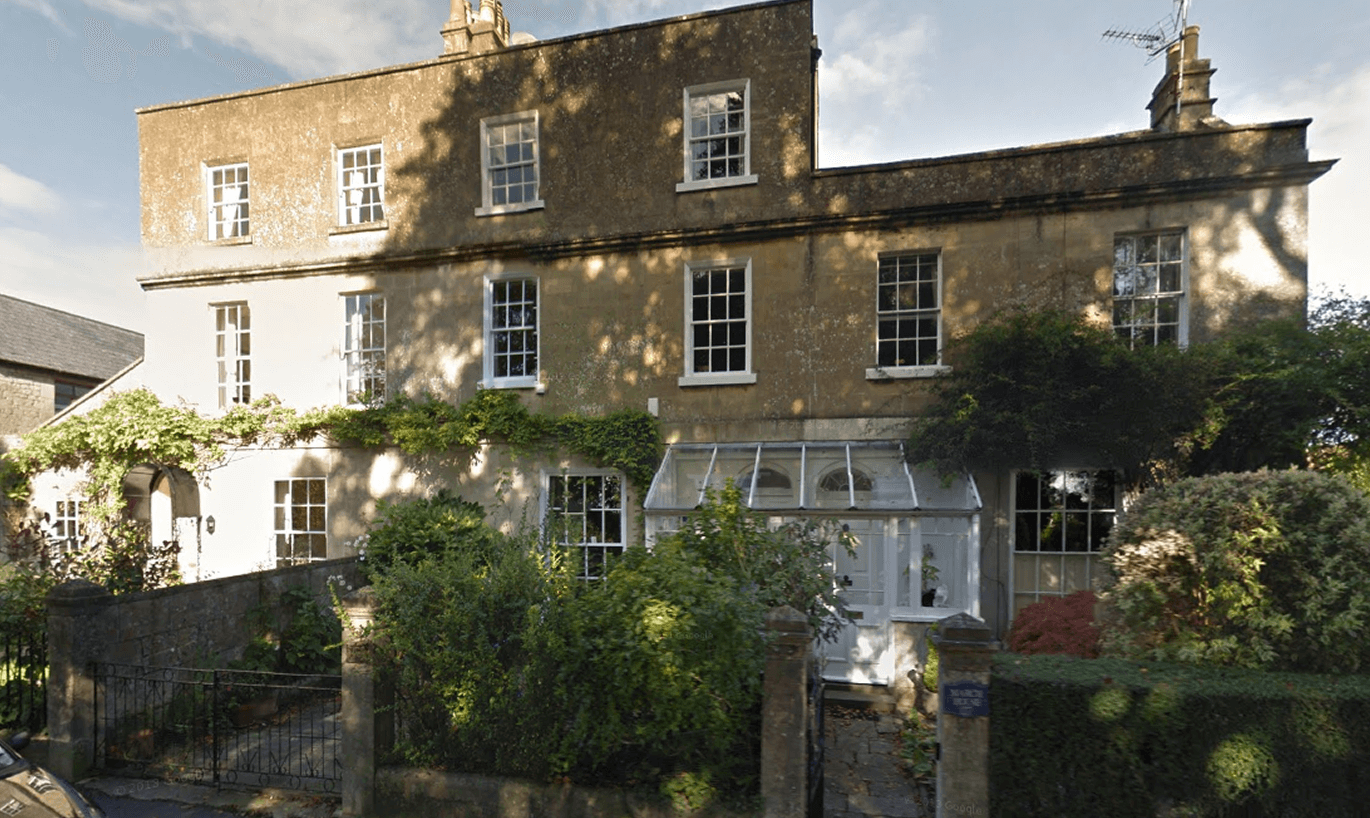
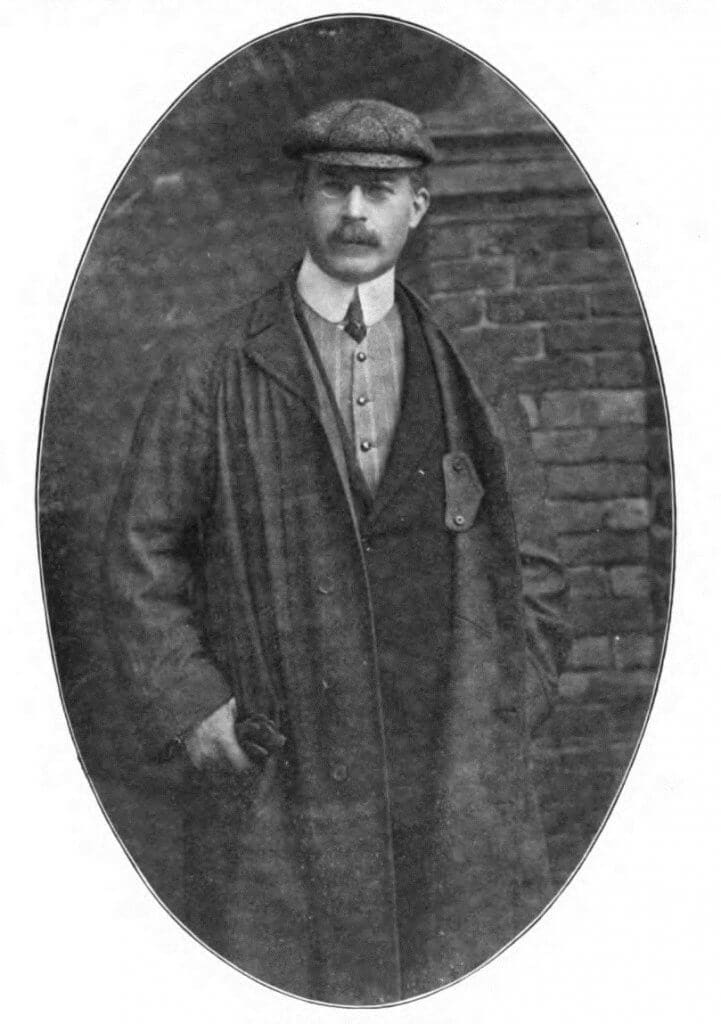
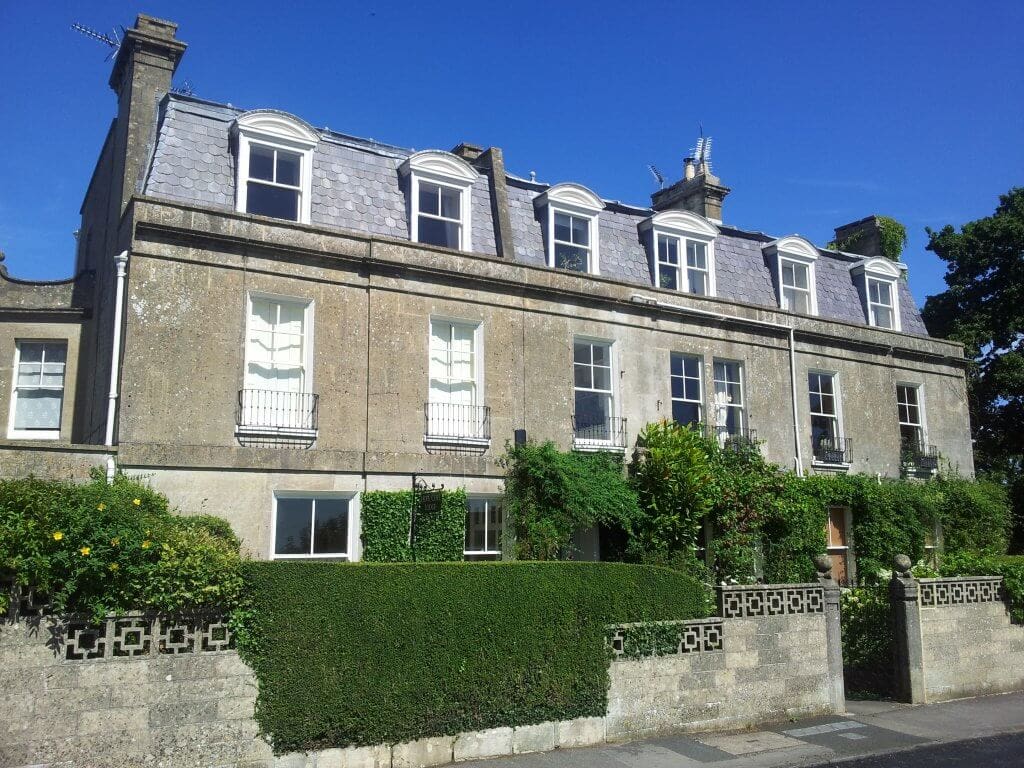
The person who most caught my eye was Patrick Young Alexander (1867 – 1943) who lived at De Montalt House. He lived an interesting life – probably helped by the fact that his father left him a very large legacy – but was also an aeronautical pioneer fascinated by the prospect of heavier than air flight, an enthusiastic balloonist and meteorologist.
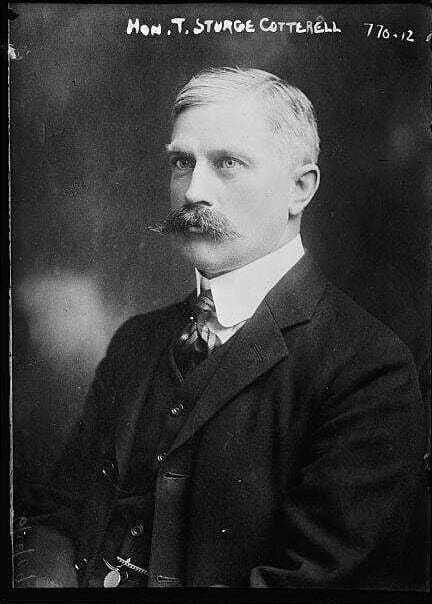
He also set up the Bath Corps of Honorary Guides. His uncle was Jacob Henry Cotterell (1817 – 1868) a land surveyor responsible for the 1852 map of Bath that appears regularly on this site.
I knew it would be difficult to find published information about the inhabitants for they were working class people – not middle class or higher and the ‘social medium’ of the day, the newspaper, did not really follow their world unless criminality or scandal was involved.
This gives a distorted image of working people’s lives. So I decided to take a look at the census, give a flavour of the range of occupations, pick out a few that were well represented and give a thumbnail sketch of those, as well as try to find some news clippings.
It’s not what I would have wanted to publish, but, if the information is not there….
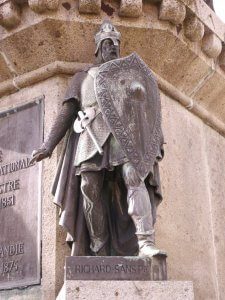
Richard the Fearless statue in Falaise, France – by Imars at English Wikipedia – Transferred from en.wikipedia to Commons., CC BY-SA 2.5, httpscommons.
Rev Alfred Richardson was married to Emma Leatham (1853 – 1925) and her great aunt Mary Leatham (1738 – 1820) was married to Thomas Howard (1736 – 1834) whose grandson was Rev Thomas Henry Howard and whose great grandson Rev Richard Nelson Howard (1852 – 1932) was vicar of Combe Down from 1892 – 1897.
He had 5 children with his second wife Gertrude Kate Fortt (1872 – 1900), who died on January 12th 1900 from heart failure. Gertrude Fortt’s great uncle was William Fortt (1796 – 1880), ‘cook, pastrycook & confectioner’, who started Fortt & Son, later Cater, Stoffel and Fortt Ltd, and who lived at Hopecote or rather 1 Claremont Buildings as it was then.
In our small area there used to be at least fourteen but now there are five.
When I first came to write this blog I thought it might be more about them, but I became side tracked and interested in why so many may have closed and whether things have changed for ever or whether the pendulum might, one day swing back.
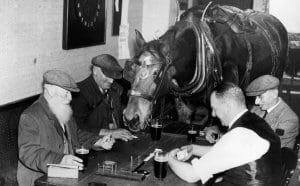
An old English pub, 1930s
When I was very much younger, in the 1970s, I had a flat in Brunswick Square in Brighton.
So did my maternal grandfather whom I did not know well as he and my grandmother had divorced before I was born.
However, he was now retired and frequented the Star of Brunswick pub in Brunswick Street West just behind the square. It has long since converted to a private home.
We spent many convivial evenings in the pub over a pint or two while he smoked his pipe. There I got to know him and there were also many regulars, much banter and laughter.
The pub has long been a social venue, a social centre for a local community, a place to meet friends and a place to foster community spirit – pubs are good for social cohesion.
A report by the Department of Experimental Psychology, University of Oxford for CAMRA called ‘Friends on Tap‘ suggests that local community pubs have unseen social benefits such as a venue in which we can serendipitously meet new, in many cases like-minded, people but also broaden our network of acquaintances and widen our experience by bringing us into contact with people from other walks of life, become more engaged with our local community and that this is likely to have significant health and wellbeing benefits.
It seems that 40% of people in the UK typically socialise with friends in someone’s home and 30% prefer to do so in pubs and feel it important to have a pub nearby, but only 20% say pubs are a regular part of their life. 72% of people go to the pub to eat.
I believe that great British pub is where the personality of the pub is created by the personality of the landlord, but a recent survey showed that it was second most important to the price and quality of the beer which is clearly dichotomous with the number of people who go there to eat.
Price and quality of the beer 33.6%
Personality of the landlord 24.6%
No music or TV screens 20.6%
But, cheaper alcohol from supermarkets, increases in rents and rates, the rise in duty and VAT, the smoking ban and a rise in the health conscious consumer have affected the British pub.
In 2003, the average adult drank 218 pints of beer but by 2011 they consumed just 152 pints with sales in pubs down 54% whereas sales from off licenses were down only 10%.
Around 40% of pubs are owned by ‘pubcos‘ but 60% are independent. The number of pubs in the UK has almost halved since 1905:
1905 99,000
1935 77,500
1951 73,400
1971 64,000
2006 58,200
2016 52,750
However, The Society of Independent Brewers report ‘British Beer‘ says that 532 million pints were brewed by its 835 members in 2015 which is an increase of 15% over 2013 and 176% over 2009. They say that well over 75% of their members’ beer is served in pubs, restaurants and hotels.
The pub is considered to be neutral territory compared with entertaining at home which makes some people feel pressured whereas the pub allows them to relax and be a less intense way of meeting people.
A pub is a hub for sociability and the bringing together of people from different walks of life in a way that no other social institution or public space can match.
We go to the pub ‘for a drink’, but ‘having a drink’ is a social act surrounded by tacit rules — a hidden etiquettes that gives us a sense of inclusion and belonging that is independent of our status in the mainstream world.
A while ago I added Belmont to the site and, as usual, I’m doing a quick update about what I found out.
It seems that the simplest way to give a flavour of Belmont, since Belmont House was constructed in the 1850s is to list some of the people who have lived in the houses in the road and what they did.
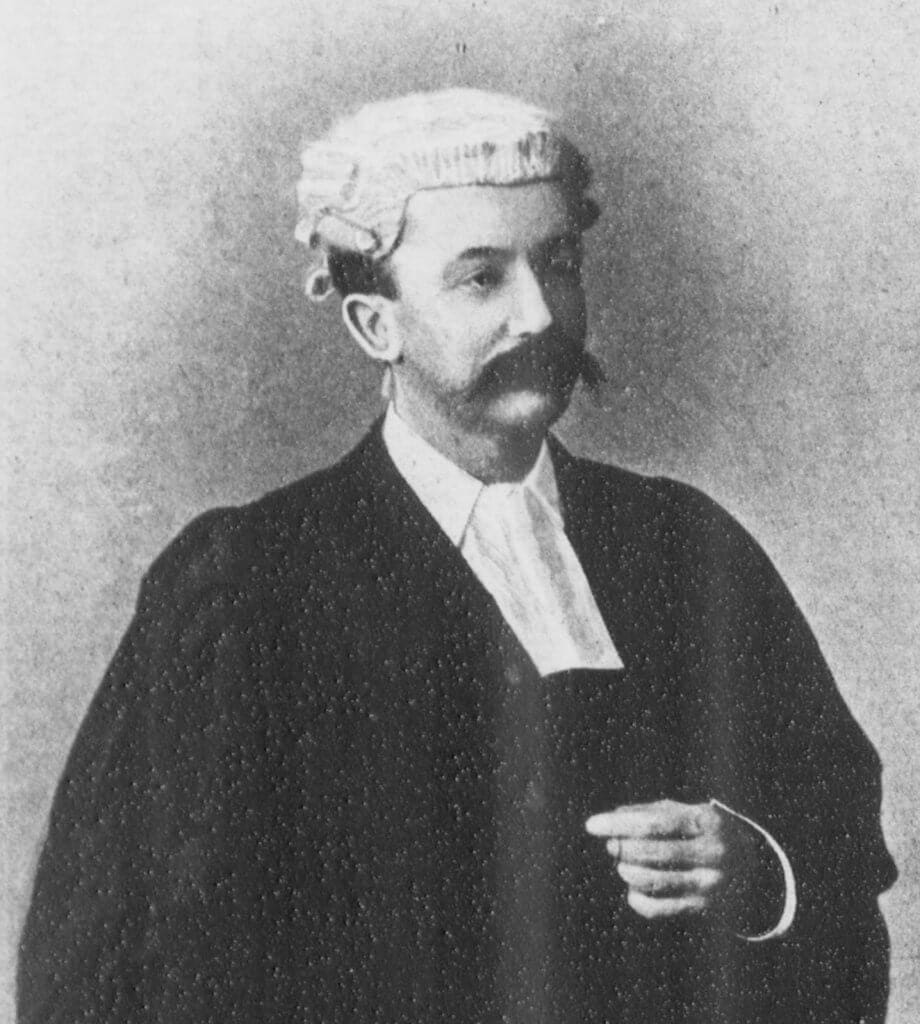
As you can see from the list below it’s, unsurprisingly for such a street with such large Victorian villas, a cross section of the 19th and 20th century British upper middle class: a Barrister, businessmen, composer, sailor, soldiers & writers.
The Garth – Annie Maria Donisthorpe (née Anderson) (1855 – 1930) divorced from Wordsworth Donisthorpe (1847 – 1914) who filed a patent for a movie camera in 1876 many years before anyone else.
I have also added a section on Claremont Buildings or Hopecote Lodge as it is now known. It, along with Isabella Place and 109 – 117 Church Road, was part of the second wave of building on Combe Down from 1800. Some interesting people lived there including William Fortt who founded Fortt’s Refreshment Rooms in Milsom Street. Forrt’s later merged with tow other Bath firms to form Cater, Stoffell & Fortt that made the famous Bath Oliver biscuits.
What is not clear is whether there was anything there before. If one looks at the rear of the houses in Isabella Place it is fairly clear that the present buildings are not the original buildings. The original buildings appear to be a terrace of five 2 up, 2 down cottages that were extended and re-fronted.
Peter Addison says in Around Combe Down (ISBN: 9780948975486) that “it is quite likely that they were originally built in the 1770s…” but is clear there is no evidence of this. Indeed there is the opposite, possible evidence that they did not exist then.
Collinson’s History of Somerset, published in 1791 says:
"On the summit of Combe Down....is a neat range of buildings belonging to this parish. It consists of 11 houses built of wrought stone raised on the spot, each of which has a small garden in front. They were originally built for the workmen employed in the quarries but are now chiefly let to invalids from Bath, who retire hither for the sake of a very fine air (probably rendered more salubrious by the plantation of firs), from which many have secured essential benefit."
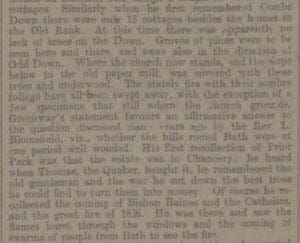
Part of interview with ‘Old John’ Greenway – Bath Chronicle and Weekly Gazette – Thursday 19 March 1896
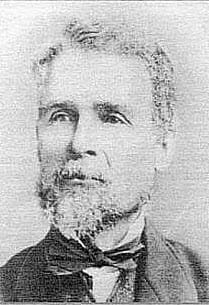
We can also read an interview with ‘Old John’ Greenway, a stonemason, published in Bath Chronicle and Weekly Gazette on Thursday 19 March 1896. ‘Old John’ was 94 at the time and had lived on Combe Down since he was an infant and in the same house (in Rock Cottages on Rock Lane) on Combe Down for 67 years since 1829.
He states clearly that that by the early 1800s there were “only 13 cottages besides the houses in the Old Rank” (De Montalt Place).
We know that Cornwallis Maude 1st Viscount Hawarden had agreed on 23rd April 1800 with Messrs. Harrold and Butler to build Isabella Place but he died in August 1803.
We also know that he had real money troubles. It’s just possible that the original design was for a terrace of five 2 up, 2 down cottages but that, after he died and his heirs had to deal with his debts and sold Isabella Place to William Harrold and William Butler, the design was changed to appeal more to the middle classes. Perhaps we will never know.
Two things stand out. The relatively large houses in Isabella Place were used as schools and boarding or lodging houses for much of the 19th century.
In these new sections I do not go into as much detail as I have for 113 – 117 Church Road.
Obtaining all the information there is about those 3 houses (and Claremont House) has taken me around 3 years and I had many of the deeds to them.
With Isabella Place having five houses, De Montalt Place having eleven and well over 150 listed houses on Combe Down, none of which I have the deeds for, though I hope to get access to those for some of them, trying to replicate the work for ‘our block’ would take …. who knows!
So what I’m doing and will do is more of a helicopter view. I still use a range of sources – directories, censuses, newspaper archives, family trees, Google, Wikipedia etc. etc. – to try to give some useful and interesting background to each particular place and the people who lived there.
Hopefully it will be found interesting and I will add to each section as more information becomes available. That’s the nature of this type of historical research – one day you are facing a blank wall and the next you discover something.
This is the last present set of family trees and take us upto c.1985. As the people who have occupied the houses since then are, mostly, still in residence or live in the area, I am not publishing their Family Trees just yet, though our own can be found at Our Blood.
(These are, now, incorporated into the “Family Maze” and all of the individual trees have been deleted from the site. They are all still available on Ancestry for anyone interested. NOTE BY RICHARD HILL ON 31 JANUARY 2024).
Perhaps the most interesting of the people this time is Cuthbert Bates who helped to pioneer the revival of interest in sixteenth and seventeenth century music in the UK.
(Please note that these family trees have been deleted and, where possible, incorporated into the family maze. They are still available on Ancestry for anyone interested). NOTE BY RICHARD HILL ON 1 FEBRUARY 2024.
I continue to add family trees. Here are more family trees for the owners and occupants of Claremont House and 113 – 117 Church Road in the period 1900 – 1950.
(These ttrees have been deleted and where possible incorporated into the family maze. The originals are still available on Ancestry for anyone interested.) NOTE BY RICHARD HILL ON 1 FEBRUARY 2024.
As usual the families are all middle class – farmer, vicar, hotel keeper (the Robinson family ran the Christopher hotel), colliery manager, bank manager, company director, naval officer.
There are still a number of trees to do for the period and it really is a “labour of love” doing the family trees!
I do them because I believethat family history is an important part of local history and vice versa. People shape how areas change over time and the type of people who lived in an area is crucial.
Much local history has been concerned with the ‘descent of the manor’ and the pedigrees and houses of the landed classes, but the lives of ‘ordinary’ people who made up most of the population is often ignored and, arguably, it’s more important.
Family history and local history can converge to produce a more complete picture of an area.
To provide the best experiences, we use technologies like cookies to store and/or access device information. Consenting to these technologies will allow us to process data such as browsing behavior or unique IDs on this site. Not consenting or withdrawing consent, may adversely affect certain features and functions.
Functional
Always active
The technical storage or access is strictly necessary for the legitimate purpose of enabling the use of a specific service explicitly requested by the subscriber or user, or for the sole purpose of carrying out the transmission of a communication over an electronic communications network.
Preferences
The technical storage or access is necessary for the legitimate purpose of storing preferences that are not requested by the subscriber or user.
Statistics
The technical storage or access that is used exclusively for statistical purposes.The technical storage or access that is used exclusively for anonymous statistical purposes. Without a subpoena, voluntary compliance on the part of your Internet Service Provider, or additional records from a third party, information stored or retrieved for this purpose alone cannot usually be used to identify you.
Marketing
The technical storage or access is required to create user profiles to send advertising, or to track the user on a website or across several websites for similar marketing purposes.