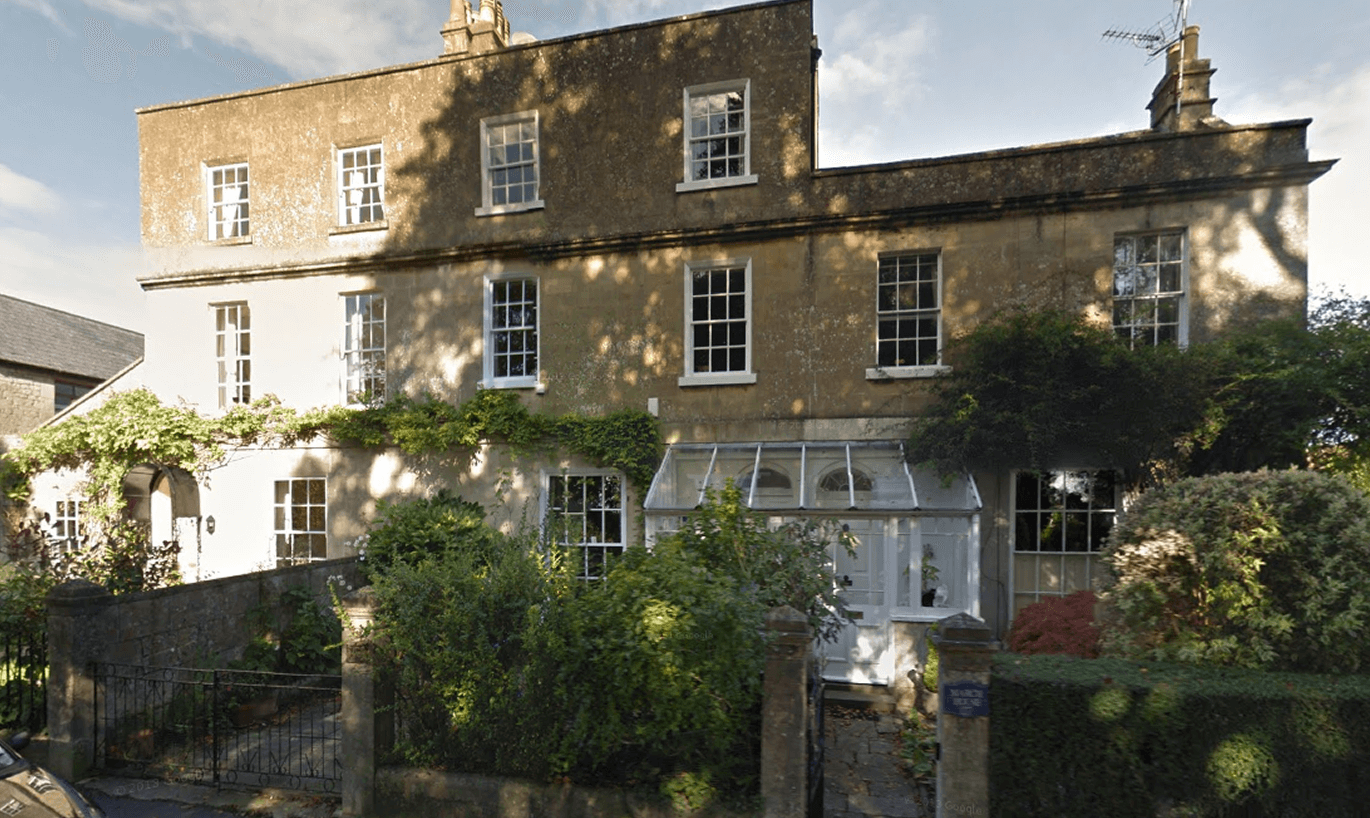
Last evening I was just preparing the evening meal for the family (if you’re interested: smoked cod and prawns poached in a butter, tarragon, garlic and peperoncino sauce, served with British asparagus, Padrón peppers and Jersey Royals, lovely!) when there was a knock at the door.
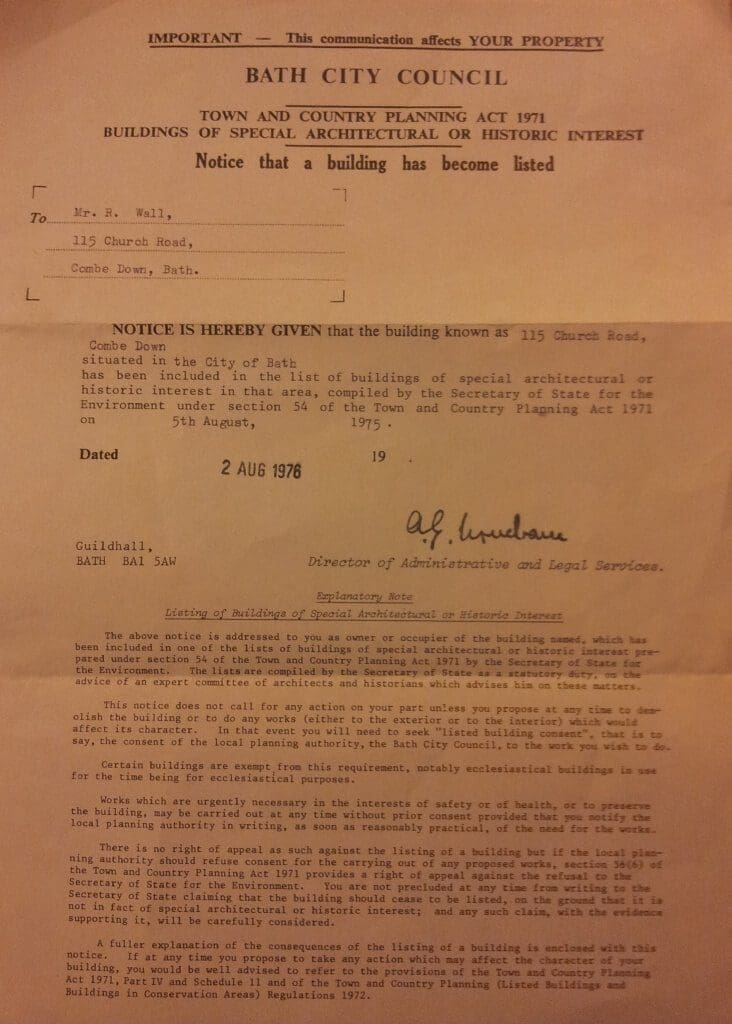
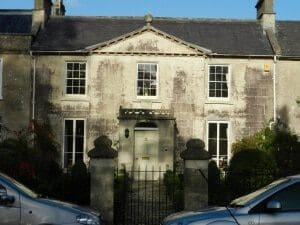
A rather lovely lady was there bringing the original listing letter sent in 1976.
As I understand things, it was found in the effects of her husband’s grandmother, Daphne Mildred Bish who died last year.
Very kindly the family decided that the current owners of the house might like it and just brought it along.
It’s a wonderful little surprise gift and I’m only sorry that I didn’t get the chance to ask her for her name and her husband’s name – I was a little flustered as the timer beeper was going off, indicating all the food was ready, just after I opened the door. Anyway, I thank them here.
The likely father of Henry Grahame Montagu (1829 – 1916), also called Henry Graham Montagu (1801 – 1872) was convicted of false pretenses and sentenced to be transported for 7 years. Henry Grahame Montagu (1829 – 1916) had 22 children.
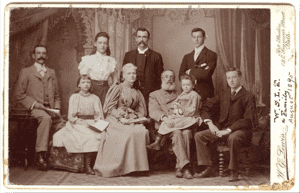
The Le Feuvre family in August 1895 (courtesy Simon Jenkins) Left to right: Charlie, Annie, Ithiel, Jane, Arthur, Samuel, Gertrude, Edmund, Vincent. Photographer: W.G. Lewis, 1 and 2, Seymour Street, Bath
As one might expect, the families are middle class but with a wide range of trades and professions from butcher to solicitor, council health inspector to carpenter, police superintendent to school teacher.
(Please note that these family trees have been deleted and where possible incorporated into the family maze. The originals are still available on Ancestry for anyone interested.) NOTE BY RICHARD HILL ON 1 FEBRUARY 2024.
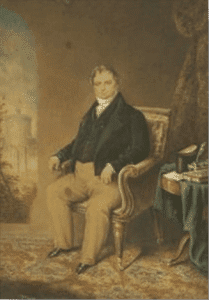
Philip Nowell by James Warren Childe (1778 – 1862)
I continue to add family trees.
Here are more family trees for the owners and occupants of Claremont House and 113 – 117 Church Road in the period to 1850.
Unsurprisingly it’s not been possible to gain information for some of these people and it’s quite scant on some of the others. Or, maybe the families really did just die out.
Anyway, some information is available for the following:
(Please note that these family trees have been deleted and where possible incorporated into the family maze. The originals are still available on Ancestry for anyone interested.) NOTE BY RICHARD HILL ON 1 FEBRUARY 2024.
There is nothing startling about any of the families. Royal naval officer, lodging house keepers and quarry masters.
All are middle class, though some are somewhat higher up the social hierarchy of the time than others and there’s no surprise in that.
Philip Nowell was clearly well off, I have just discovered some information in The Gazette which hints at his wealth:
TO be sold, pursuant to an Order of the High Court of Chancery, made in the matter of the estate of Philip Nowell late of Grosvenor Wharf, Lower Belgrave-place, Pimlico, in the county of Middlesex, and of Rock Hall, Combe Down, near Bath, in the county of Somerset, Esquire, and in a cause Cruse v. Nowell, with the approbation of the Vice-Chancellor Sir Richard Torin Kindersley, the Judge to whose Court the said matter and cause are attached, at the Auction Mart, in the city of London, on Tuesday th« 22nd day of May, 1855, at two o'clock in the afternoon, in two lots;: A wharf, called the Grosvenor Wharf, situate in Lower Belgrave-place, Pimlico. in the county of Middlesex, with an extensive quay abutting on the basin of the Grosvenor Canal, with warehouses, counting-house, and stabling; thereto belonging, and to messuages or dwelling-houses, being Nos. 27 and 28, in Lower Belgrave-place, Pimlico aforesaid, and two messuages, being Nos. 1 and 2, Nowell's cottages, Wilton-road, Pimlico aforesaid. And also a wharf with entrance gates from the Wilton-road, Pimlico, with an extensive quay abutting on the basin of the said Grosvenor Canal, and the warehouses, workshops, drying-rooms, anda forge thereto belonging, and six messuages or dwelling houses, being Nos. 3, 4, 5, 6, 7, and 8, Nowell's cottages aforesaid. Printed particulars and conditions of sale may be had (gratis) of Mr. Robert Pope, of No. 11, Gray's-inn-square, Holborn ; of Mr. R. G. Smith, Solicitor, No. 5, New-inn, Strand; of Messrs. Maples and Co., Solicitors, Frederick'splace, Old Jewry; and of M'ssrs. Dunn and Gibbs, the Auctioneers. No. 7, Great Tower-street; and at Mr. Smith's, No. 25, Ebury-street, Pimlico. The messuage, No. 27, Lower Belgrave-place, may be viewed by cards only, to be obtained as above, the remaining property may be viewed with the consent of the respective tenants.
TO he sold, pursuant to an Order of the High Court of Chancery, made in the matter of the estate of Philip Nowell, late of Grosvenor-wharf, Lower Belgrave-place, Pimlico, in the county of Middlesex, and of Rock Hall, Combe Down, near Bath, in the county of Somerset, Esq., and in a cause Cruse against Nowell, with the approbation of the Vice-Chancellor Sir Richard Torin Kindersley, the Judge to whose Court the said matter and cause are attached by Mr. W. J. Stent, the person appointed for that purpose at the Bath Arms Hotel, Warminster, in the county of Wilts, on Tuesday the 29th day of May, 1855, at six o'clock ia the afternoon, in seven lots: Three freehold messuages or dwelling-houses, with the appurtenances thereto belonging, situate at Sarnbourne-hill, and in Back-street, in the town of Warminister aforesaid. Also four leasehold messuages or dwelling-houses, with the appurtenances, situate in and being Nos. 4, 5, 6, and 7, George-street, in the said town of Warminster. Printed particulars and conditions of sale may be had (gratis) in London of Mr. Robert Pope, No. 11, Gray's-inn square Holborn; of Mr. R. G. Smith, Solicitor, No. 5, New Inn, Strand; and of Messrs. Maples and Co., Solicitors, Frederick's-place, Old Jewry ; and in the country of Mr. Thick, Solicitor, Cheltenham; of Mr. Stone, Solicitor, Bath; of the Auctioneer, Warminster; and at the place of sale.
TO be sold, pursuant to an Order of the High Court of Chancery, made in the matter of the estate of Philip Nowell, late of Grosvenor Wharf, Lower Belgrave-place, Pimlico, in the county of Middlesex, and of Rock Hall, Combe Down, near Bath, in the county of Somerset, Esquire, deceased, and in a cause Cruse v. Nowell, with the approbation of the Vice-Chancellor Sir Richard Torin Kindersley, the Judge to whose Court the said matter and cause are attached, by Mr. J. W. Sient, the person appointed for that purpose, at the Langford Inn, in Churchill, in the county of Somerset, on Thursday, the 31st day of May, 1855, at six o'clock in the afternoon, in two lots: Three several closes of arable, meadow, and orchard land, containing by estimation HA. 2R. 5P., or thereabouts, situate in the parish of Churchill, in the said county of Somerset, in the occupation of Mr. Henry Dando, as a yearly tenant. And also a piece of meadow land, containing by estimation 4A. 2n. 7P., or thereabouts, situate in the parish of Wrington, in the said county of Somerset, also in the occupation of the said Mr. Dando. Printed particulars and conditions of sale may be had (gratis) in London, of Mr. Robert Pope, Solicitor, No. 11, Gray's-inn-square, Holborn; of Mr. R. G. Smith, Solicitor, No. 5, New-inn, Strand; and of Messrs. Maples and Co., Solicitors, Frederick's-place, Old Jewry; and in the country of Mr. Thick, Solicitor, Cheltenham; of Mr. Stone, Solicitor, Bath ; of the Auctioneer, Warminster; and at the place of sale.
After his death his will led to a case in Chancery:
CRUSE V NOWELL

Exparte: Philip Nowell late of Grosvenor Wharf, Lower Belgrave Place, Pimlico, Middlesex and of Rock Hall, Combe Down near Bath, Somerset, esq.
Document type: Administration summons.
Application made by: Anne Barnard Cruse, Emma Nowell Cruse, Edward Nowell Cruse and George Frederick Cruse, infants by Edward Cruse their next friend of 70 Cambridge Street, Ecclestone Square, Pimlico, Middlesex, professor of music.
Short title: Cruse v Nowell.
Plaintiffs: Anne Barnard Cruse, Emma Nowell Cruse, Edward Nowell Cruse and George Frederick Cruse, infants by Edward Cruse their next friend.
Defendants: Philipp Nowell and Arthur Nowell.
Date: 1853
His sons Philip and Arthur had received £10,000 (worth about £1 million now) in trust for his daughter Mary and, in the event of here death his other children.
Mary died, but so did another of his children, Catherine, who died while he was still alive and the question was about whether this meant her ‘share’ lapsed. It was decided it did.
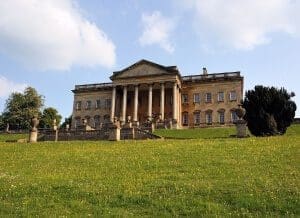
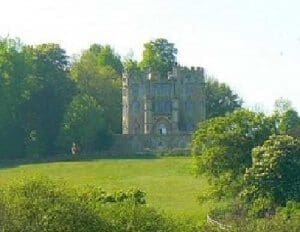
The first ones were of the gentry who owned the large houses in the area – Prior Park, Combe Grove, Midford Castle and the other early movers in the development of Combe Down.
In the 19th century there were no building societies as we know them today. Property was still a good and secure investment, even though possession of land and its economic and political importance was diminishing as trade became more important. Like today, however, buying a house outright was beyond the means of most people. Mortgages were arranged privately and a mortgage was, primarily, a way of raising money (for the mortgagor or debtor) and investing money at interest (for the mortgagee).
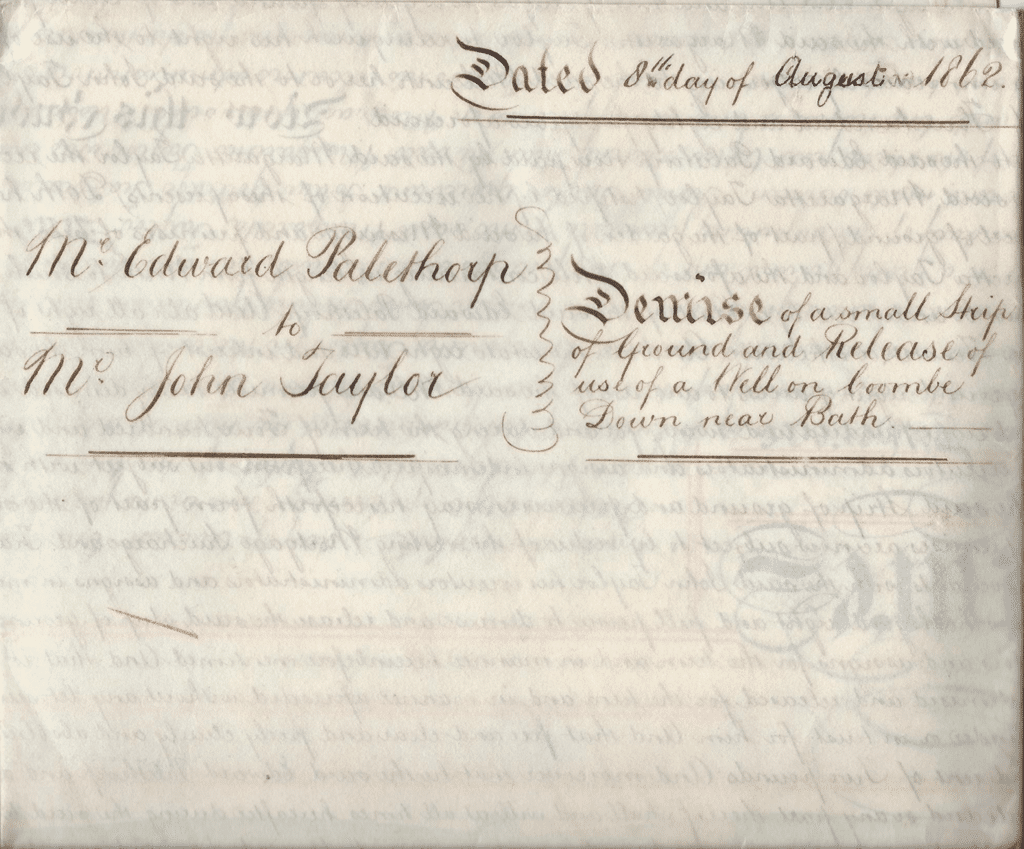
Even so, one might assume that the balance of power was weighted heavily in favour of the mortgagee, especially when looking at the wording of deeds for mortgages and property. These show that mortgagors gave ownership of land to the mortgagee until he repaid a debt the owed by a certain time. If he repaid the debt the mortgagee would re-convey the land to the mortgagor. If the mortgagor failed to repay the debt by the time that was specified in the mortgage, the land became the mortgagee’s.
However from the 16th century onwards the English equity courts intervened on the side of the mortgagor. Equity gave the mortgagor a right to redeem the land by paying the amount that was owing, even after he had defaulted on the debt, so long as he did so within a “reasonable time.” In order to clear their title to the land after the mortgagor had defaulted, mortgagees brought actions in equity to foreclose the mortgagor’s “equity of redemption.” In a foreclosure, equity gave the mortgagor a right to the proceeds of the sale of the land to the extent that the sale realized more than the outstanding amount of the debt. Legislation in the 19th century extended the mortgagor’s right to redeem to a fixed period after the mortgagee had foreclosed.
So, whilst the Owners of 109, 113, 115 & 117 Church Road, Combe Down before 1850 were indeed the owners they were not landlords. If they ‘wanted out’, then they would assign their interest in a mortgage to another person, who would pay him the money he was owed. Now the mortgagor had a new person to deal with, to pay interest to every year, and eventually, to repay the capital sum. This can be seen in the deeds.
I’ve just reordered the site somewhat into Now and Then.
The, slightly punning, title of the book was Prior to Now and that became the website title too.
Combe Down Area Directory
A thought that I always had, was that the site could include the history of Combe Down (Prior) and what’s going on now (Now).
I have now put all the history (but not the people and family trees) under one section Combe Down Then and what’s going on now under, believe it or not, Combe Down Now.
One area that I’d particularly like to add to is Combe Down photos – especially any historic ones whether they be from your own or family archives or from postcards etc.
If you have any other ideas for what might be useful or relevant on the site then I’m always happy to ‘hear ideas’.
I have, now and then, wondered about a forum that includes the ability to post events etc. but I’m not sure whether it would be used and then there’s the question of moderation. Unfortunately there are always idiots who try to ruin it for the good guys, but it’s reasonably easy to do if there’s any demand.
Other than that I hope the new elements add to the site and that you enjoy them.
which tells us that in 1870 – 72, John Marius Wilson’s Imperial Gazetteer of England and Wales described Combe Down like this:
“COMBE-DOWN, a chapelry in Combe-Monckton parish, Somerset; near the Great Western railway and the river Avon, 2 miles S of Bath. It has a post office‡ under Bath. Pop., 940. A hill, giving name to the place, is 550 feet high; commands an extensive prospect; yields Bath stone in large quarries; is pierced and cut with caverns and passages; and bears on its slope a pleasant little town, with villas, an inn, and the church. The living is a vicarage in the diocese of Bath and Wells. Value, not reported.* Patron, the Vicar of South Stoke“.
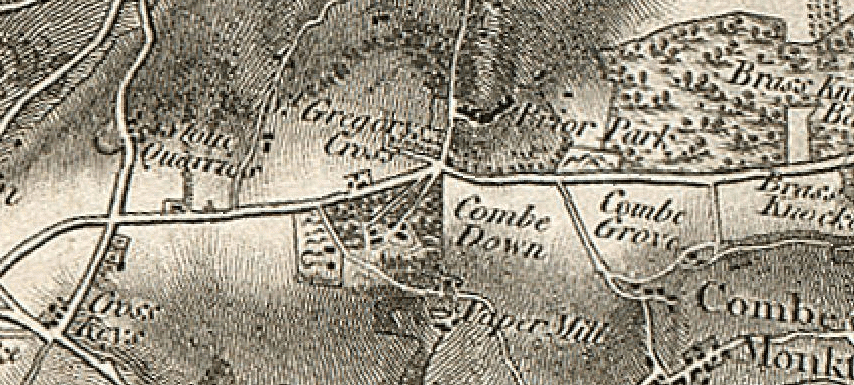
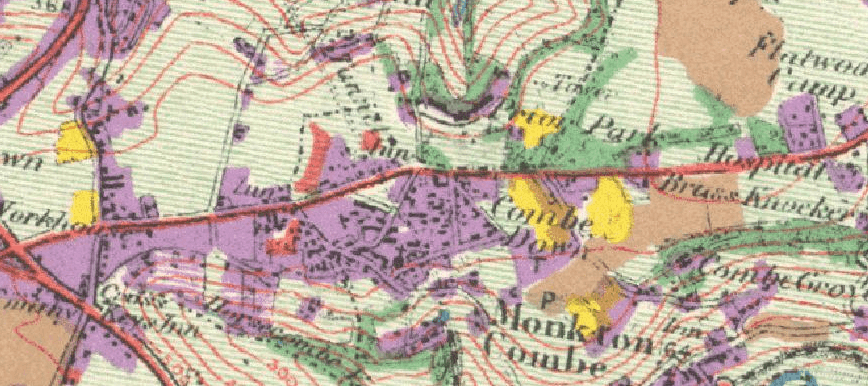
Historical maps
There’s also a link to historical maps that you can see, often, as a seamless map overlaying the modern equivalent and/or download the original free.
Historical map of Combe Down
There are general purpose topographic historical maps:
Dial House, De Montalt Place, Combe Down – one of the listed buildings
I have just added a page for Listed Buildings on Combe Down and in Midford and Monkton Combe divided into 15 areas which are in a rough circle as follows:
Now I do, though I’d dearly love more photos to add to the galleries, so, if you have any that you’d be willing to let me publish then please do let me have a copy.
I have introduced a Family Trees Centre to Prior to Now to help to sort out who was who and their relationships one to another.
Some of the more important families and people in the story of Combe Down from 1700 – 1900 have been added so far and a list of the trees and some of the individuals is shown below.
I have used a different link colour and rollover for Family Tree links and introduced some Family Tree links into the text within the pages too.
Something else that comes out of it, if you are interested in history and genealogy as I am, is the ‘shape’ of families – it’s strange how similar patterns seem to repeat in each family, with some branches thriving and others dying out.
What’s also interesting is the way some families have stayed prosperous over many centuries.
Other things also emerge such as the builder of Midford Castle, Henry Woolhouse Disney Roebuck (1733 – 1796) having ancestors that include: Edward I, King of England (1239 – 1307) 13th and 14th great grandfather, Edward II, King of England (1284 – 1327) 13th great grandfather, Edward III, King of England (1312 – 1377) 12th great grandfather.
ZeeThe fact that the Bennet family, of Widcombe Manor, and the D’Isney (Disney) family of Midford Castle came together when Maj Philip Bennet (1837 – 1875 ) married Barbara Sophia Harriet Disney (1838 – 1929) the cousin 3 times removed of Henry Woolhouse Disney Roebuck (1733 – 1796).
Disney Roebuck family tree. Builder of Midford Castle, Henry Woolhouse Disney Roebuck (1733 – 1796). [Ancestors include: Edward I, King of England (1239 – 1307) 13th and 14th great grandfather, Edward II, King of England (1284 – 1327) 13th great grandfather, Edward III, King of England (1312 – 1377) 12th great grandfather].
I was just looking at the Hunt & Co. and Silverthorne directories for Bath and Bristol for 1848 and 1846 respectively and thought it would be interesting to see what went on in the village around then – what was it like on Combe Down around 1846 – 1848? Who is mentioned? What trades and professions?
The problem is that, unlike later Kelly’s directories that locate a place and then show the people living there plus their occupations etc. these earlier directories are alphabetical and by class, so it’s not so simple to get an idea of what was going on.
Luckily, in this age of the internet you can find ‘electronic’ copies of most things, which makes it easier to do a search and then……
The results are below and provide an interesting snapshot of some of the people who lived and worked here.
I find a number of things interesting, compared to today.
For example the use of ‘nobility and gentry’ and people describing themselves as ‘gent’.
The boarding and day schools situated in private houses.
The fact that there were actually shops in the village (!) – no cars or supermarkets then.
Additionally, given the total population of 1,600 – 1,750 there are, unlike say the old telephone directories, actually very few people listed.
One other thing is the blacksmith. In Silverthorne’s of 1846 it is George Humphries but by Hunt & Co of 1848 it is Harriett Humphries – presumably his wife or daughter. But, was she the owner or did she actually smith? It would be interesting to know.
The census’ for 1841 and 1851 also give a picture and are shown below the directory findings.
Some interesting things were going on with property on Combe Down around this time.
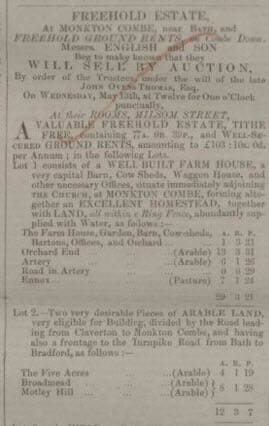
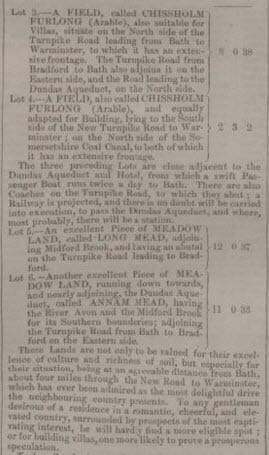
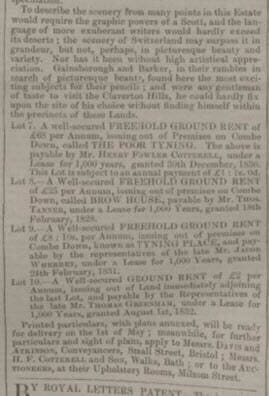
John Ovens Thomas (1778 – 1836), the eldest son of John Thomas, the owner of Prior Park had died 10 years earlier but in 1846 his trustees decided to sell much of the land he had inherited from his father as well as some of his ground rents. The land, as can be seen from the estate sale notice below included the farm next door to St. Michael and All Angels Church at Monkton Combe, a number of fields near the Dundas Acqueduct and Midford Brook as well as ground rents for the Tyning Road area, The Brow, and Tyning Place.
John Ovens Thomas estate sale – Bath Chronicle and Weekly Gazette – Thursday 16 April 1846
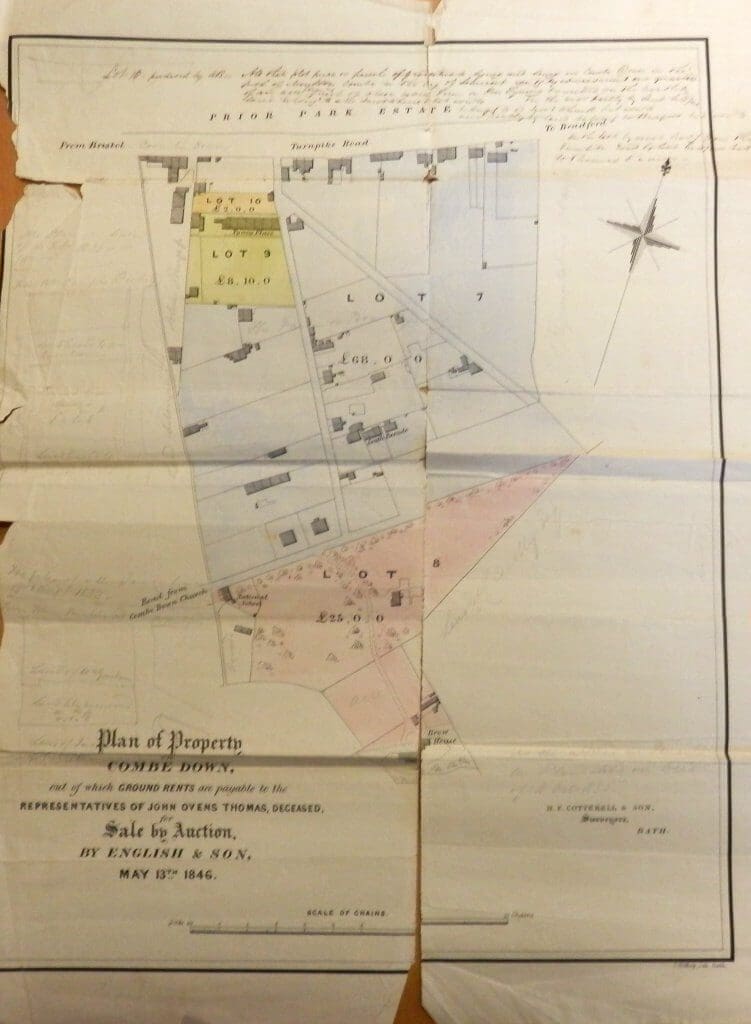
It also included the land from North Road to Church Road as the map below shows, The map also gives a really good idea of what this area of Combe Down was like in 1846.
Map of Combe Down plots for sale from estate of John Oven Thomas in 1846
Hunts & Co 1848
Nobility, Gentry, &c.
Baskett Mrs. Sarah, 6, De Montalt place, Combe down
Payne John, overseer of the parish of Monkton Combe, Park villa, Combe down
Radburn George, quarry master, Combe down
Rawlings William, Carriage Inn, Combe down
Ricketts Charles, carpenter & joiner, Combe down
Salter Job, 1, Priory cottages, Combe down
Spence Samuel, Hadley Arms, and quarry master, Combe down
Stinnard & Ford, quarry masters, Combe down
Stodart John, 2, Claremout buildings, Combe down
Sumsion Isaac, quarry master, 1, Park place, Combe down
Vincent William, boot & shoe maker, 9, Cheap street — p. r. Combe down
Whitaker William, boot and shoe maker, Combe down
Wren Thomas Jay, short hand writer, and stationer, Combe down
Churches
Trinity, Combe down. — Sunday, 11 morn. and 6 even. Sacrament administered the first Sunday in the month. Rector, Rev. George Newnham. Curate, -Rev. D. Topham.
To provide the best experiences, we use technologies like cookies to store and/or access device information. Consenting to these technologies will allow us to process data such as browsing behavior or unique IDs on this site. Not consenting or withdrawing consent, may adversely affect certain features and functions.
Functional
Always active
The technical storage or access is strictly necessary for the legitimate purpose of enabling the use of a specific service explicitly requested by the subscriber or user, or for the sole purpose of carrying out the transmission of a communication over an electronic communications network.
Preferences
The technical storage or access is necessary for the legitimate purpose of storing preferences that are not requested by the subscriber or user.
Statistics
The technical storage or access that is used exclusively for statistical purposes.The technical storage or access that is used exclusively for anonymous statistical purposes. Without a subpoena, voluntary compliance on the part of your Internet Service Provider, or additional records from a third party, information stored or retrieved for this purpose alone cannot usually be used to identify you.
Marketing
The technical storage or access is required to create user profiles to send advertising, or to track the user on a website or across several websites for similar marketing purposes.